For universities & colleges
Campus digital signage on Apple TV
Your campus already owns Apple TVs in lecture theatres, faculty buildings, libraries and common rooms, and most of them sit idle. Billboard turns the whole fleet into signage, run from one dashboard, rolled out with Jamf, Intune or Mosyle, and priced flat by screen count instead of per screen. It scales, IT can work with it, and universities across Australia and beyond already run on it.

See it on your campus screens
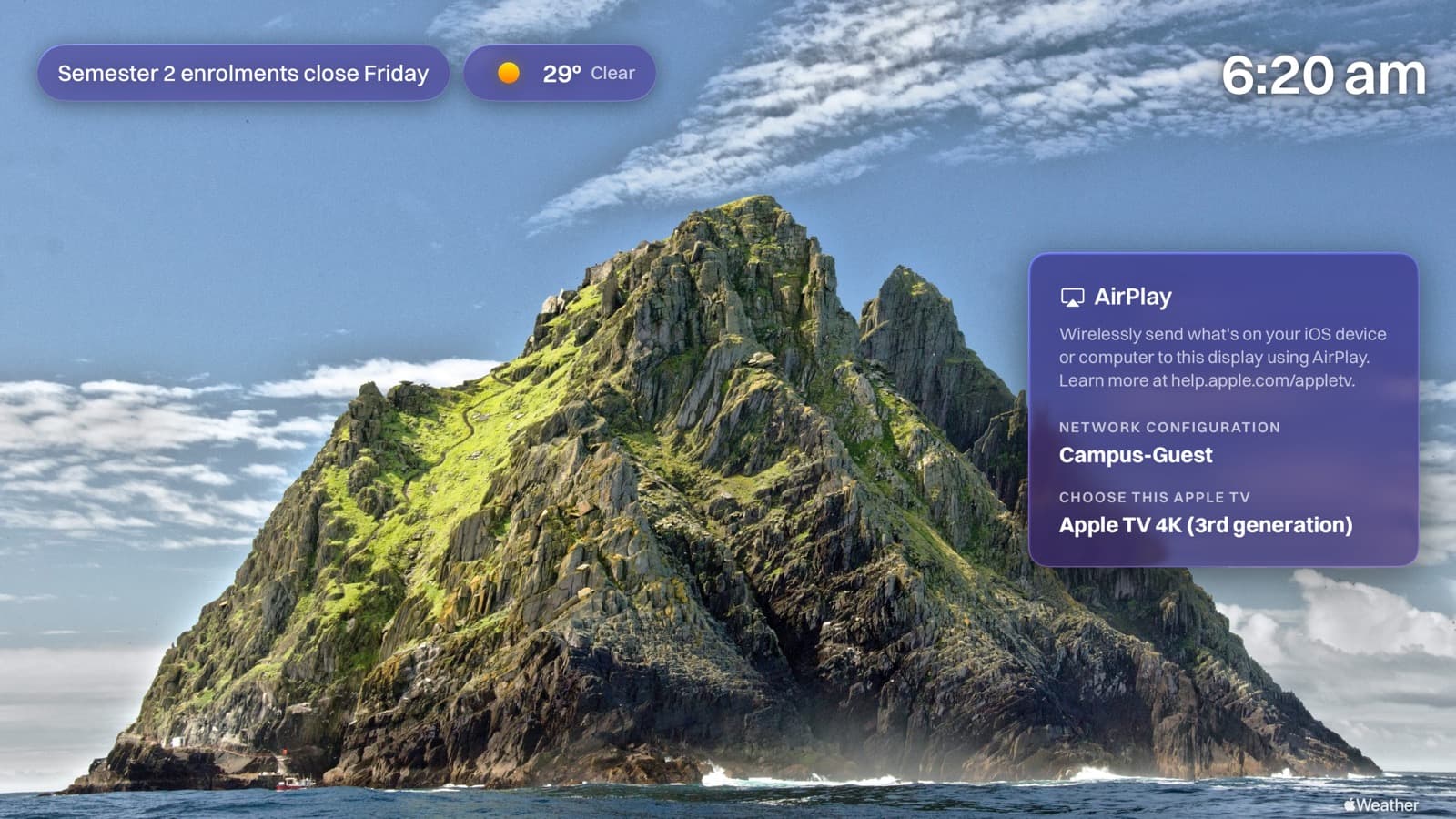
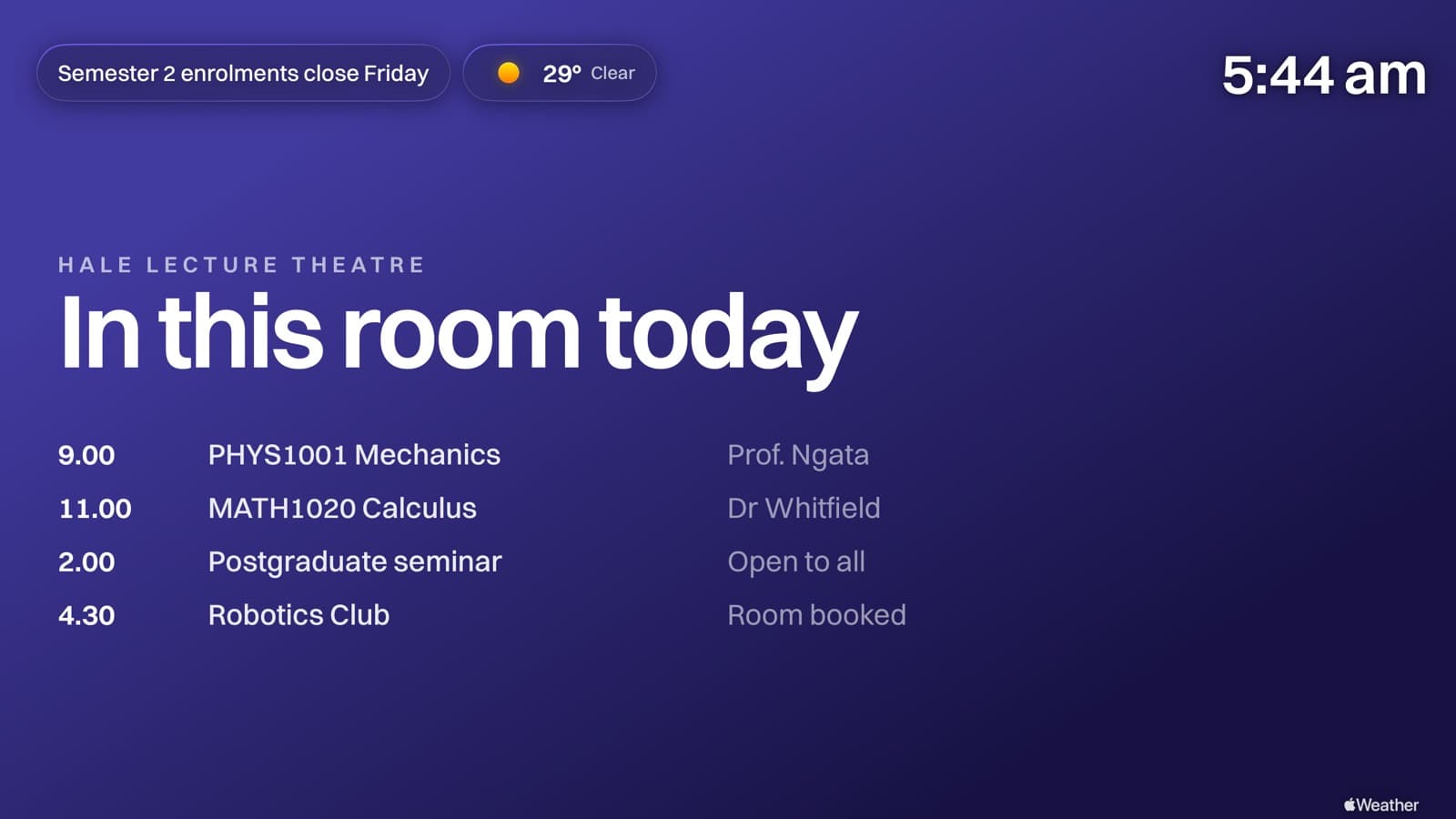
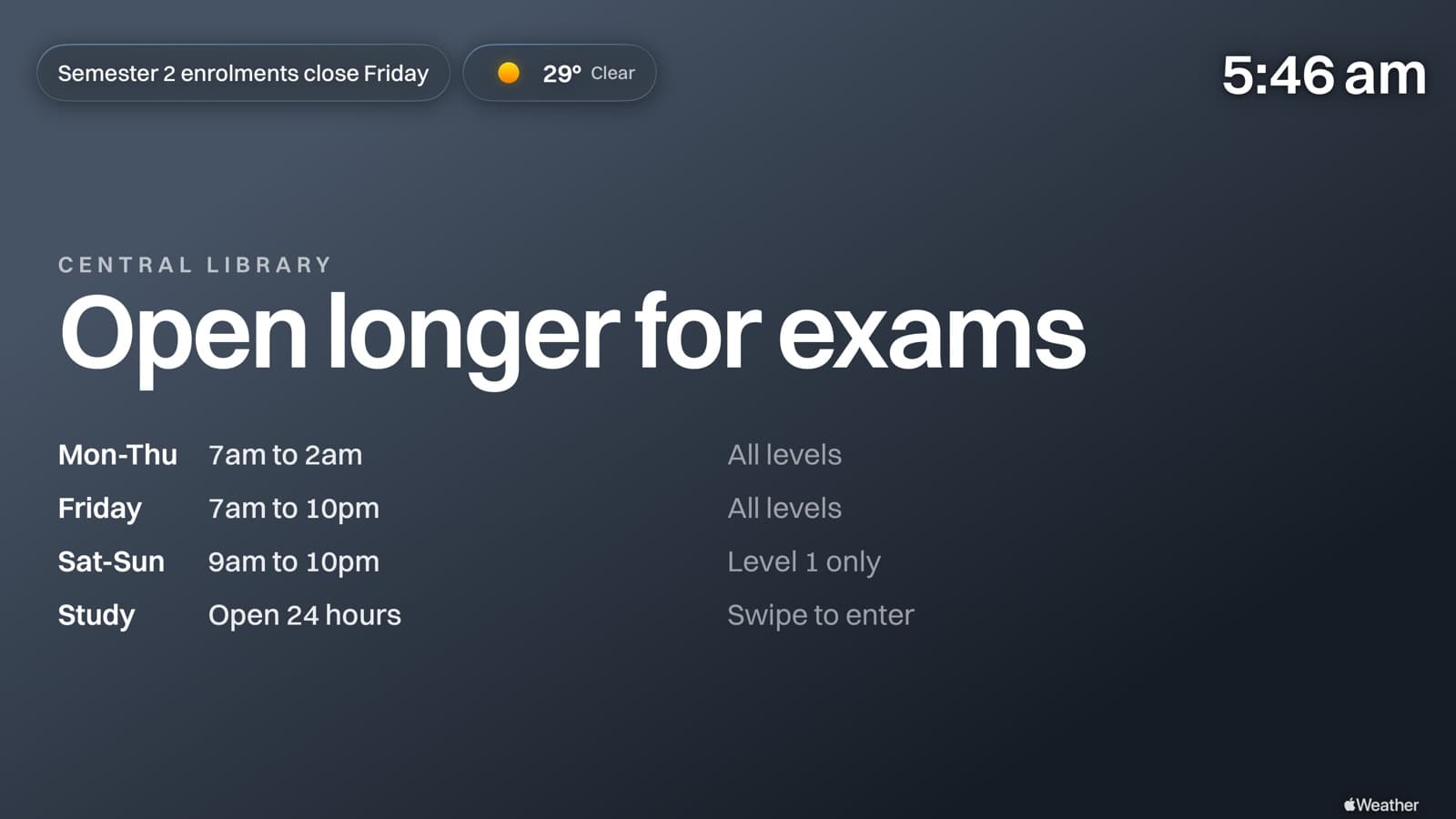
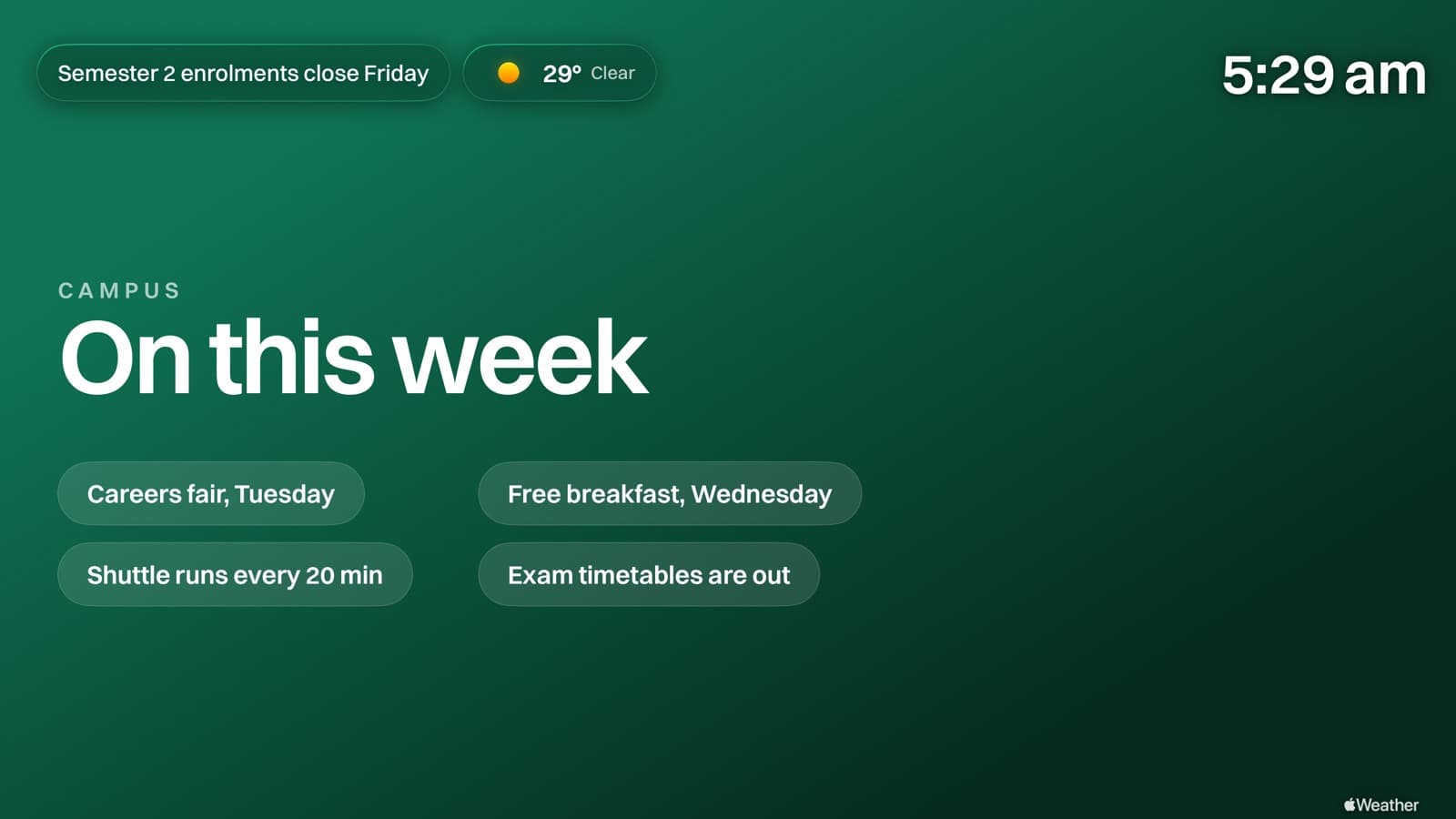
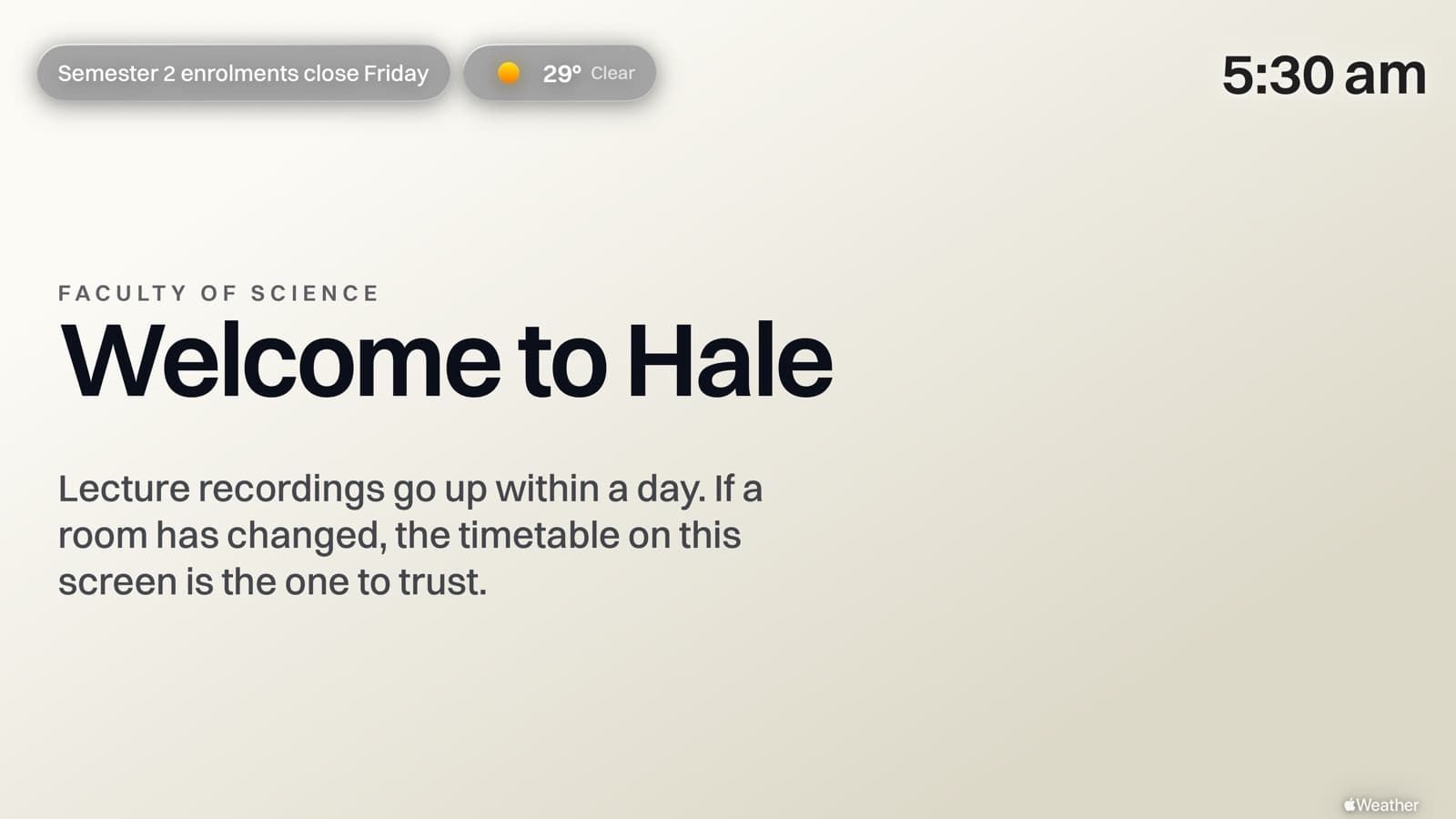
Lecture theatre timetables, library hours in exam week, campus notices, and AirPlay ready the moment a lecturer walks in.
Portrait
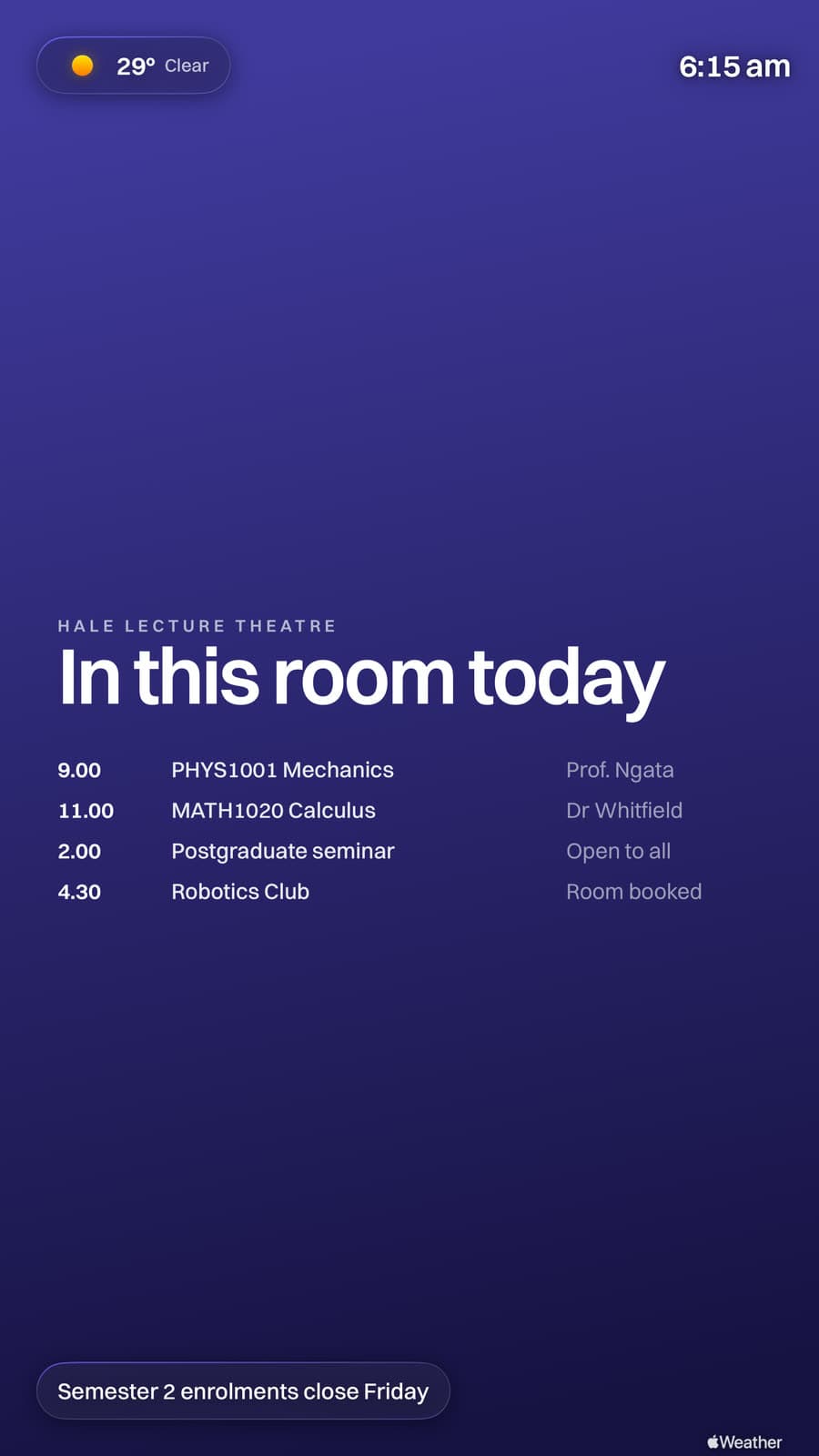
Turn the screen. It follows.
Wayfinding pillars and lift lobbies are usually upright. Rotate a screen and the whole layout reflows to match, type included, off the same gallery as the landscape ones.
Built for many buildings
A gallery per space or faculty, each with its own code, all managed in one place. Point as many screens as you like at any of them.
No new hardware
Works on any Apple TV you already own. Nothing to buy, nothing to wire in.
Built for IT & MDM
Roll out across hundreds of Apple TVs with Jamf, Mosyle, Intune or Apple Configurator. Enter a code, or push it as managed config through Apple School Manager.
Per-site details
Show a different network name or branding per building, even when the content gallery is shared, through managed configuration.
AirPlay that still works
Anyone casts to the screen in one tap, exactly like Conference Mode. Lessons and meetings never skip a beat.
Flat, predictable pricing
One flat price set by number of screens, monthly or annual, never per screen. Easy to budget, easy to get approved.
See the full feature list, pricing, how flat rate beats per-screen, or the deployment guides for Jamf, Mosyle, Intune and Apple Configurator.
Deployment
Push it to four hundred Apple TVs without touching one.
Billboard is an ordinary tvOS app with managed app configuration, so your MDM installs it and tells each screen which gallery to play, what to call itself and which network to name. Unbox, enrol, done. Nobody walks a remote around the building.
One policy, every screen named after its room
Most MDMs substitute per-device variables, so a single configuration gives every Apple TV its own name while sharing everything else. Point a whole site at one gallery, or a different gallery per building.
<dict>
  <key>dataURL</key>
  <string>https://getbillboard.app/m/XHA8TKJH</string>

  <key>deviceName</key>
  <string>$DEVICENAME</string>

  <key>airplayWifiNetwork</key>
  <string>Riverside-Guest</string>

  <key>airplayTint</key>
  <string>#1E3A8A</string>

  <key>screenRotation</key>
  <integer>0</integer>

  <key>showClock</key>
  <true/>
</dict>
The keys you will actually set
Managed config outranks whatever is set on the device, so a screen that someone has fiddled with comes back into line on its next check-in.
- dataURL
- String
- Which gallery this screen plays
- deviceName
- String
- The name shown on the AirPlay panel
- airplayWifiNetwork
- String
- The network people should join
- airplayTint
- String
- Your brand colour, as hex
- airplayOpacity
- String
- Frosted, medium or glass
- screenRotation
- Integer
- 0 or 90, for upright mounts
- showClock
- Boolean
- Clock in the corner
- logoURL
- String
- Your mark in the top bar
A written guide for every one of these
Buying through Apple Business or School Manager works the same way. Add Billboard to Volume Purchasing and your MDM installs it like anything else.
For estates and IT
What the people who run the fleet will ask
A campus rollout is a procurement conversation before it is a design one, so here is the deployment and data picture in one place.
- Can different faculties run their own screens?
- Yes, and that is the usual arrangement. Each space gets its own gallery and its own code, so a faculty updates its own lecture theatres without being able to touch anyone else's. Central IT still deploys and still owns the account.
- What does it need on the network?
- Outbound HTTPS to our CDN, and that is the whole list. No inbound rules, no VPN, no static addresses, no per-device accounts. A screen fetches a small JSON manifest on the interval you set and pulls media it has not seen before, so a gallery that has not changed costs a few kilobytes a check.
- How much bandwidth per screen?
- A screen caches what it has already downloaded, so ongoing traffic is the manifest check plus anything new you upload. A fleet on a fifteen-minute check does not register against a school's connection. Set a longer interval on a constrained site and the screens simply update less often.
- Does it keep the Apple TVs updatable?
- Yes, and this is the one people get caught by. An Apple TV parked in Conference Mode mostly sits frozen on that screen, so tvOS updates queue and never land. Billboard is an ordinary app, so your devices keep patching on whatever schedule you set.
- What happens if the network drops?
- The screen carries on playing the last good manifest and the media it has cached, and picks the feed back up when the connection returns. A dropped link is a screen that stops updating, not a screen that goes black in a reception area.
- Who can change what?
- Galleries are separate, each with its own unguessable code, so the drama department cannot alter the front office screens. Apps like weather, boards and alerts can be switched off account-wide, which removes them from every editor at once rather than relying on people being told.
- What do you hold about students?
- Nothing about them. There are no student records, no accounts on the devices and no analytics on the TVs. What we store is the media you upload and the settings for each gallery. A screen is a read-only consumer of a manifest, so nothing flows back from the wall.
Frequently asked questions
- Can Billboard scale across a whole campus?
- Yes. Run every screen from one dashboard, a gallery per space, and roll out to hundreds of Apple TVs with your MDM (Jamf, Mosyle, Intune or Apple Configurator).
- Can different buildings show different content?
- Yes. Give each building its own gallery, or share a single content gallery and vary the per-site details, like the network name shown, with managed app configuration.
- Do we need dedicated signage hardware?
- No. It runs on standard Apple TVs, so there are no signage players to buy or keep running.
- How is it priced for higher education?
- One flat price set by how many screens are active, monthly or annual, never per screen. Start free on two screens.
- Does Billboard suit Australian universities?
- Yes. Universities in Australia already use it, and we bill in Australian dollars. It runs on any Apple TV, so it works across Australian campuses and colleges as well as it does overseas.
Signage for the whole campus
Start free, set up your galleries, and be ready to roll out across every building.
Get started free